
October 16, 2026 | CR4PR Water Watch
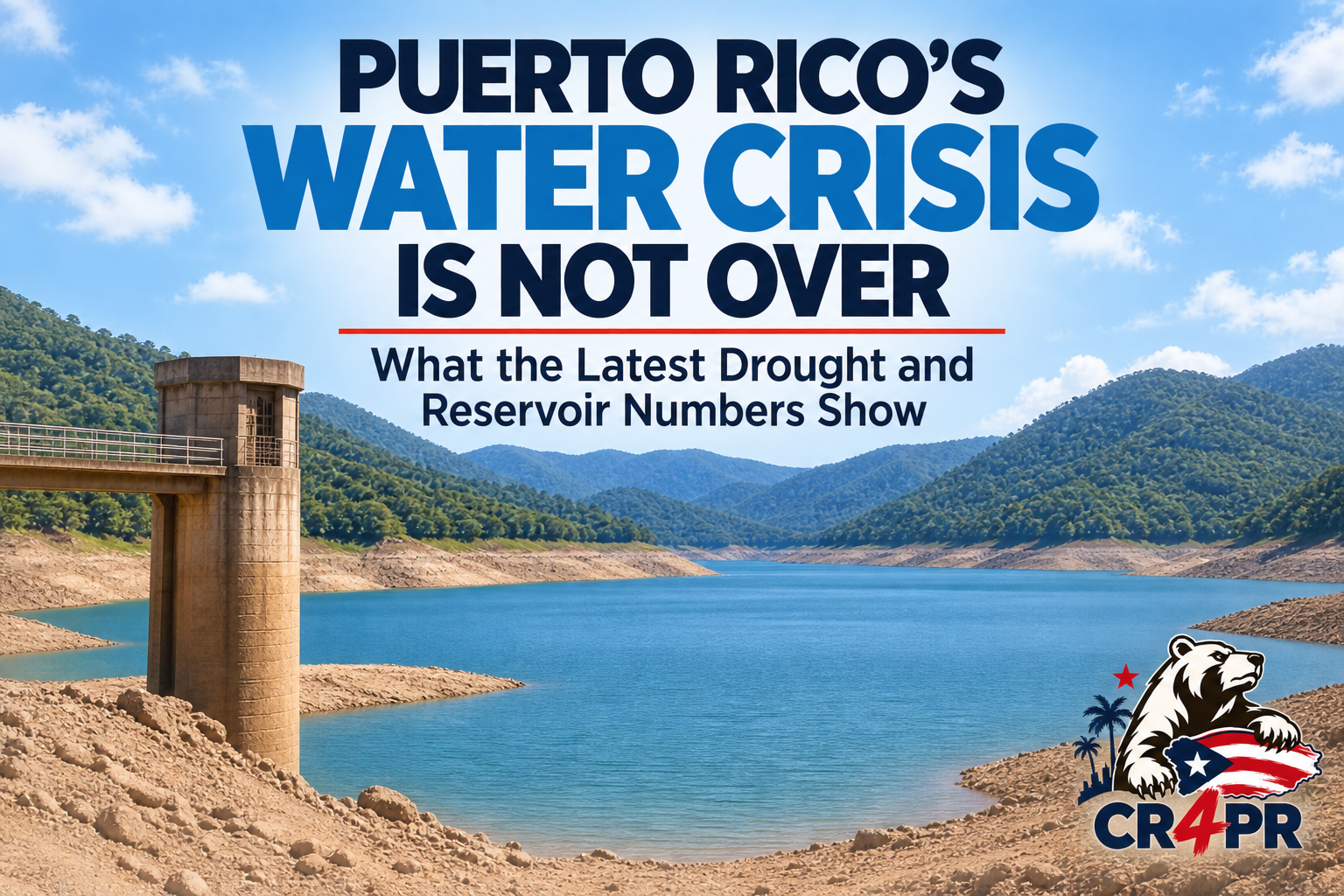
Featured image: Original conceptual illustration, not to scale or a depiction of a specific reservoir or aquifer.
For families planning around water interruptions, a higher reservoir reading can bring hope. It cannot answer every question about the water available to their community.
Puerto Rico’s latest monitoring shows improvement alongside continuing pressure on water supplies. The clearest way to understand that picture is to keep three things separate: reservoir elevations, groundwater conditions, and the service notices that apply to a particular neighborhood.
This update follows CR4PR’s September 13 water report, with new October measurements and a closer look at the water stored underground.
In this update
- Reservoir snapshot
- Elevation vs. storage
- Groundwater
- Drought updates
- Resident resources
- Why it matters
- How Californians can help
October 16 reservoir snapshot
The AAA’s October 16, 2026 daily chart, marked as updated at 5:00 a.m., reports:
- Carraízo: 40.87 meters, up 0.02 meters, or 2 centimeters, in the Seguridad category.
- La Plata: 43.39 meters, down 0.08 meters, or 8 centimeters, in the Ajustes category.
The AAA reservoir page describes these measurements as meters above sea level and compares changes with the previous day’s 5:00 a.m. reading. These are a dated snapshot, not live readings for the entire day.
Seguridad and Ajustes are operational reservoir categories. They should not be read as drinking-water safety certifications or guarantees of uninterrupted household service. Puerto Rico’s Institute of Statistics describes the categories as operational classifications.
The contrast also matters: Carraízo’s small daily increase and La Plata’s decline show why one reservoir cannot stand in for the island’s entire water supply.
Elevation is not the amount of water in storage
A reservoir elevation tells us where the water surface sits relative to a reference level. It does not directly tell us the number of gallons available, the percentage of usable storage remaining, or how many days that supply will last.
Storage is a volume. Converting an elevation into volume requires information about the reservoir’s shape and a stage-storage relationship. USGS reservoir surveys use those relationships to calculate storage at different water levels. A rise of one meter therefore cannot be translated into a fixed amount of water across different reservoirs. See this USGS reservoir-capacity study.
For readers comparing dashboards, the measurement time and reference level also matter. USGS publishes separate elevation series using different vertical datums for Carraízo, also called Lago Loíza, and La Plata. Comparing unlike series can create an apparent change that is not a real rise or fall in the water.
Groundwater needs its own recovery
Groundwater occupies pores and fractures in saturated material below the surface. Rain that infiltrates deeply enough can replenish it through a process called recharge. The USGS groundwater explainer describes how that water moves through the ground and can eventually reach streams and lakes.
Well levels reflect both replenishment and withdrawals. USGS explains that pumping and drought can lower groundwater levels, particularly when water is removed faster than it is replaced.
Surface water and groundwater are connected, but they are not interchangeable measurements. USGS describes their interaction as dependent on the local hydrologic setting. The practical conclusion is straightforward: improvement in a metro-area reservoir is not evidence that southern aquifers have recovered.
What the October drought updates say
The October 8 NIDIS regional update used information available by October 6, 2026, at 5:00 p.m. Atlantic Time. It reported that late-September rain replenished some reservoirs, while southern groundwater remained stressed. It also reported two wells at critical thresholds, attributing that assessment to Puerto Rico’s Department of Natural and Environmental Resources. That is a dated agency assessment, not a new October 16 measurement of those wells.
A newer U.S. Drought Monitor summary for October 13, 2026, accompanying the October 15 release, confirms further improvement in parts of Puerto Rico. However, severe and extreme drought remained in portions of the southern plains. Critically low groundwater in the south-southeast and reservoir concerns in the Río de la Plata Basin limited further improvement.
The newer report supports cautious optimism, with continued attention to the places recovering more slowly.
What residents can do with this information
- Check your service zone, not just a reservoir headline. AAA’s Mi Zona map provides zone information, service status, cycle changes and oasis locations. Confirm the latest notice before planning around a schedule.
- Keep the date attached when sharing an update. A morning reservoir chart, a weekly drought map and an earlier groundwater assessment describe different moments and different parts of the system.
- Use water carefully and follow local instructions. Report leaks and service problems through AAA’s official channels. A favorable reservoir category is not a reason to disregard a notice for your neighborhood.
- Help neighbors find the information that applies to them. Checking a service notice together can be especially useful for someone without reliable internet access or transportation.
Why this matters
Water uncertainty can disrupt the ordinary work of caring for a household, running a business or tending a farm. Clear, dated information helps people plan without minimizing what communities are experiencing. Rainfall gains deserve recognition, and residents whose local supplies remain under pressure deserve sustained attention. Reliable recovery must be assessed across reservoirs, aquifers and the service people actually receive.
How we in California can help Puerto Rico
We can start by checking in with family and friends in Puerto Rico and asking what would actually help. Share dated official updates, not alarming screenshots without context. Offer to help someone find their AAA service zone or read a local notice.
Before organizing supplies or fundraising, ask established community organizations in the affected area what they need and verify how support will reach residents. Avoid sending goods nobody has requested. From California, useful solidarity means listening locally, sharing accurate information and supporting priorities identified by the people doing the work in Puerto Rico.